
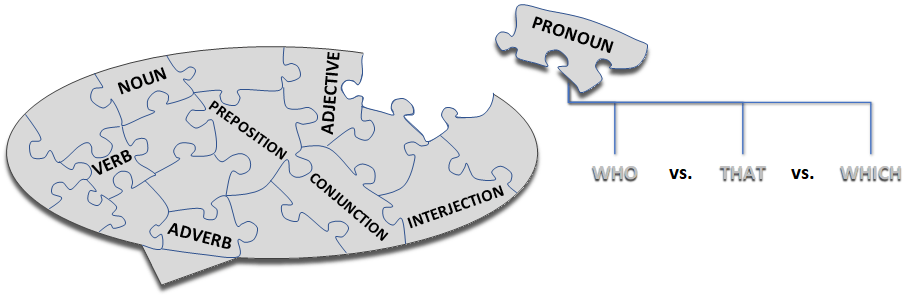
The pronouns who, that, and which are often used interchangeably when it is not grammatically correct to do so. This post highlights the basic differences in usage. At a high level:
- WHO – always required when referring to people
- THAT – refers to animals, things or ideas
- WHICH – replaces that when acting as the object of a non-restrictive clause
To better understand the difference between that and which, we need to explain what restrictive and non-restrictive clauses are.
Restrictive Clause: phrase that narrows a category or identifies a particular item in that category
- EXAMPLE: Manuscripts that are unsolicited by the publisher will be returned to the sender.
If the clause “that are unsolicited by the publisher” is removed, the meaning of this sentence changes to indicate that all manuscripts will be returned.
Non-Restrictive Clause: also known as a parenthetical clause, this provides additional information about the subject and can be removed without changing the meaning of the sentence
- EXAMPLE: Mary’s book, which was on sale, is about the Civil War.
If the clause “which was on sale” is removed, the meaning of this sentence does not change. The non-restrictive clause provides additional information that does not directly relate to the meaning of the primary clause.
Regardless of whether the clause is restrictive or non-restrictive, if the pronoun refers to a person, who is required.
- EXAMPLE: The lady who brought the chocolate cake is my neighbor.
- EXAMPLE: Mary, who is editor and chief of the school newspaper, hopes to pursue a writing career.
This completes our short refresher on the major parts of speech. When we return, we will dive into the rules for proper punctuation.
 centralhoustoniwa.com
Leave a comment