
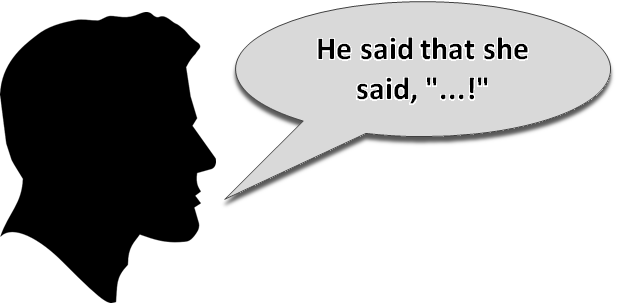
One of the more misused punctuation marks is the pair of quotation marks, or quotes. Quotes are naturally associated with dialogue and references to material taken from other sources, but there are other uses as well.
We have two types of quotation marks: single (‘ ’) and double (“ ”). Following is a list of the most common uses for each mark.
Single Quotes
Single quotes are used to indicate quotations within a quotation.
- EXAMPLE: Elizabeth said, “My favorite verse in the book of Proverbs states the following: ‘Commit to the Lord whatever you do, and your plans will succeed.’”
The closing double quote follows the single quote (…succeed . ’ ”), and the period is inside the single quote. When typesetting for a book or an article, the editor will place a hair space between the single and double marks at the end.
Double Quotes
Double quotes are used in all of the following applications:
Spoken statement in dialogue
- EXAMPLE: Mary said, “I am planning to hold a big celebration when my first book is published.”
Direct quotation from another speaker or printed material
- EXAMPLE: This age of phenomenal technological advancements and unbelievable social depravity can best be described with Dickens’ iconic line: “It was the best of times, it was the worst of times.”
Title of a written piece that is NOT a stand-alone work,
e.g. a poem, article or story within a compilation
- EXAMPLE: “Ickle Me, Pickle Me, Tickle Me Too” is one of the poems in Shel Silverstein’s famous compilation Where the Sidewalk Ends.
Word chosen sarcastically or with an uncommon use
- EXAMPLE: Taking the “shortcut” ended up tripling our drive time because of unexpected road construction.
Now that we know which applications require the use of quotation marks, let’s look at how to properly position the quotes in the sentence. Commas, periods, colons, semi-colons, question marks, and exclamation points follow different rules with regard to their placement relative to the closing quote.
Commas and Periods
Closing quotes always come after a comma or period.
- EXAMPLE: The writers’ conference will have workshops titled “Characterization and Body Language,” “Plot Development,” and “Book Proposals.”
Colons and Semi-Colons
Closing quotes always come before a colon or semi-colon.
- EXAMPLE: Larry wrote a poem titled “I Fell in Love with Your Crooked Nose”; his girlfriend was not impressed.
- EXAMPLE: There were three actors mentioned in the article “Who’s Who in Hollywood”: Bruce Willis, Harrison Ford, and Sean Connery.
Question Marks and Exclamation Points
Closing quotes are positioned before a question mark or exclamation point unless the question mark or exclamation point is part of the quoted material.
- EXAMPLE: Did you know that the first story in Uncle Wiggily’s Adventures is “Uncle Wiggily Starts Off”?
- EXAMPLE: With fist raised defiantly to the sky, Scarlett vowed, “I will never go hungry again!”
This concludes our refresher on quotation marks and the most commonly used or misused punctuation marks. Remember that the rules for punctuation may vary depending on which style guide you are using, and the style guides go into far greater detail than we can cover in this blog. So, it behooves you to keep your style guide on-hand whenever you are writing!
Stay tuned for our next grammar post where we will be looking at proper sentence construction.
 centralhoustoniwa.com
Leave a comment