
Variety is the spice of life, as they say. The same holds true with our writing. Mixing up our sentence structures makes for more interesting reading.
You’ll also find that certain structures fit certain genres. For example, short, snappy sentences carry the action forward at a quick pace for mystery and action thrillers while longer compound sentences are more effective in introspective narratives.
All sentences fall into one of four categories: simple, compound, complex, or compound-complex. The simple sentence contains the basic components that must be present in every sentence. Compound, complex, and compound-complex sentences build on this simple structure to link related ideas and provide additional detail modifying the core elements.
Simple Sentence
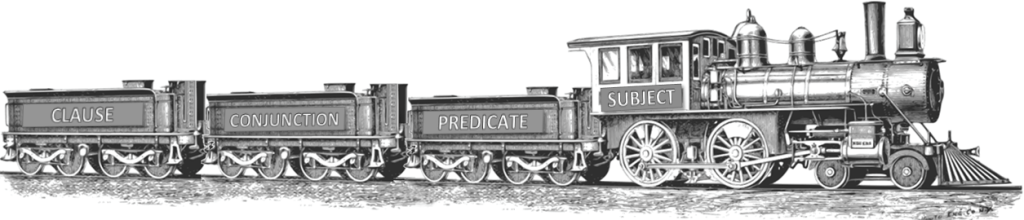
You can think of a sentence like a train where each element is strung together to create a complete thought. In this train, there are only two required components: the engine and the first car.
Subject
The subject is the engine of the train. This is the person or object that is performing the action. The action may be dynamic if the engine is moving or tooting its horn. Or the action may be static if you are pointing out the engine’s state of being.
Predicate
The predicate is the first train car and it states what the subject is doing. In its simplest form, the predicate consists of a single action verb or verb of being.
Susan writes.
Subject = Susan | Predicate = writes
If we need to know more about the subject and the action, we can add descriptive modifiers describing the subject along with how, what, when, why, and where the action is taking place. Check out our first post on the parts of speech for more details on this.
Sister Susan writes psalms in the sanctuary.
“Sister” reveals Susan’s title. | “Psalms” is the direct object of the verb “writes,” and “in the sanctuary” is the prepositional phrase indicating where the verb takes place.
Compound Subjects and Compound Predicates
A simple sentence may also have multiple subjects performing the same action or multiple actions performed by the same subject. These are called compound subjects and compound predicates.
Sister Susan and Brother Anthony write psalms in the sanctuary.
Compound Subject: both Susan and Anthony must perform the same action if this is to have the simple sentence structure.
Sister Susan sings and writes psalms in the sanctuary.
Compound Predicate: both the singing and the writing must be performed by the same subject if this is to have the simple sentence structure.
Sister Susan and Brother Anthony sing and write psalms in the sanctuary.
Compound Subject & Compound Predicate: both subjects must perform both actions if this is to have the simple sentence structure.
Do you see how only two words are required to complete the sentence, but even within the simple sentence structure, we have the ability to expand upon the action to provide additional detail?
If we need to link a dependent clause or we have multiple subjects performing different actions, then we must graduate to the compound, complex, or compound-complex structure.
Compound Sentence
Compound sentences consist of two independent clauses linked together with a conjunction. An independent clause that stands alone is actually a simple sentence with its own subject and predicate. So, we can think of this as two trains linked together where each train has its own engine and at least one car.

Sister Susan writes psalms in the sanctuary, and Brother Anthony sings.
These are two independent clauses (simple sentences) joined with the conjunction “and.” Each subject is performing a different action.
The compound sentence structure can also link two independent clauses that, technically, refer to the same subject but replace the name of the subject with a pronoun in the second clause. The pronoun is treated as a separate subject in this case.
Sister Susan writes psalms in the sanctuary, and she sings what she has composed.
If the pronoun “she” were omitted, the two actions would be combined into a compound predicate as they were in the simple sentence example above. If the pronoun “she” is included for clarity, the two actions must be assigned to their own independent clauses. “Susan” is the subject of the first clause, and “she” is the subject of the second.
TRAIN WRECK: RUN-ON SENTENCE
Susan writes, Anthony sings.
Two or more independent clauses joined without a conjunction or semi-colon
Complex Sentence
A complex sentence links a dependent clause to a simple sentence. If we are to understand how to construct these sentences, we must know how to identify dependent clauses. Unlike the independent clause, a dependent clause left on its own does not form a complete sentence.
At first glance, the dependent clause may look like it has the necessary engine with car in tow, but there is also a pesky subordinating conjunction hitched to the front of the engine. With this subordinating conjunction in place, the engine cannot pull the train; it must be linked to another sentence.

Although Susan has a sound studio in her home, she writes her psalms in the sanctuary.
Subordinating Conjunction = Although | With the subordinating conjunction, “Susan” is no longer a subject and “has” is no longer a predicate verb. The entire dependent clause functions as an adverb modifying “writes.” This clause must be joined to the simple sentence “she writes” in order to make a complete sentence.
TRAIN WRECK: INCOMPLETE SENTENCE
Although Susan has a sound studio.
Stand-alone dependent clause
Compound-Complex Sentence
Compound-complex sentences, as their name implies, combine the elements of the compound sentence and the complex sentence. These sentences must include one dependent clause and at least two independent clauses.
Although Sister Susan has a sound studio in her home, she writes her psalms in the sanctuary, and Brother Anthony joins her to sing along.
“Although” introduces the dependent clause. “She writes” composes the base subject and predicate of the first independent clause. “Anthony joins” composes the base subject and predicate of the second independent clause.
This concludes our overview of sentence structure. Now that you are able to identify what constitutes a complete sentence, be sure to apply the appropriate punctuation to mark the end of each sentence.
With the exception of dialogue, a period (.), question mark (?), or exclamation mark (!) always terminates a sentence, and a sentence can only be terminated using one of these marks or an ellipsis (…). So, if you are not trying to terminate the sentence, other punctuation is required. Refer back to our punctuation part 1 and part 2 posts for more details on this.
Stay tuned for our next grammar post where we will explore some of the more intricate rules governing capitalization.
 centralhoustoniwa.com
Leave a comment